Clothing Manufacturing Process:
What Happens After You Contact a Manufacturer?
Introduction
Starting a clothing project can feel straightforward at first. You have a design, product idea, or reference sample, and the next step seems to be finding a clothing manufacturer.
But what happens after you make that first contact?
The clothing manufacturing process involves much more than simply sending a design and receiving finished garments. Before production begins, a manufacturer needs to understand the product, materials, measurements, quantity, branding requirements, and expected timeline.
For new and growing brands, understanding the apparel manufacturing process can make communication easier and help avoid costly misunderstandings later.
This guide explains the typical clothing production process, including what happens after the initial inquiry, how samples are developed, when production begins, and what you should pay attention to at each stage.
- Introduction
- Key Takeaways
- 1. The Process Starts With Your Product Requirements
- 2. Design and Specification Review
- 3. Fabric Selection and Material Planning
- 4. Quotation and Production Planning
- 5. Sample Development
- 6. Sample Review and Revisions
- 7. Production Preparation
- 8. Bulk Production
- 9. Quality Checking and Final Inspection
- 10. Packing and Delivery
- What Should You Expect From a Clothing Manufacturer?
- A Better Way to Approach Apparel Production
- Conclusion
Key Takeaways
- A clothing project usually starts with a clear understanding of the product requirements, not with bulk production.
- Fabric selection can affect fit, appearance, performance, cost, and lead time, so it should be discussed early.
- Sampling gives both the brand and manufacturer an opportunity to identify and correct issues before bulk production.
- An approved sample and confirmed specifications should become the reference for production.
- The clothing manufacturing process involves more than sewing. Production coordination, communication, and quality checking are important throughout the project.
1. The Process Starts With Your Product Requirements
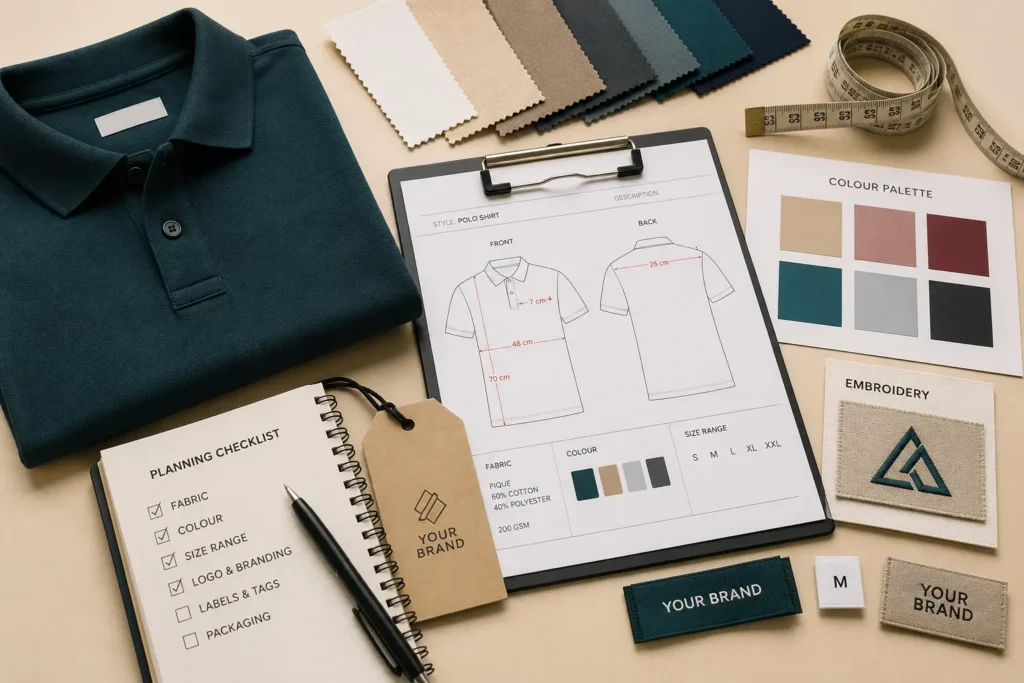
The clothing manufacturing process usually begins with information from the customer.
This does not always mean you need a complete technical specification package. Some brands approach a clothing manufacturer with a finished tech pack, while others may only have sketches, reference images, measurements, or an existing garment.
The more useful information you can provide at the beginning, the easier it is for the manufacturer to evaluate the project.
Useful information can include:
- Product type
- Design references or sketches
- Size range
- Estimated quantity
- Preferred fabric
- Fabric weight or GSM
- Colour requirements
- Printing or embroidery
- Labels and branding
- Packaging requirements
- Target delivery date
If you are still preparing your information, see our guide on What to Prepare Before Contacting a Clothing Manufacturer for a useful starting point.
The goal at this stage is not to have every detail perfect. Instead, it is to give the manufacturer enough information to understand what you are trying to produce.
2. Design and Specification Review
Once a clothing manufacturer receives the initial requirements, the next step is normally to review the product.
This is an important part of the apparel manufacturing process because a design that looks simple visually may involve more complicated construction.
For example, a basic T-shirt may still require decisions about:
- Collar construction
- Shoulder seams
- Sleeve shape
- Fabric stretch
- Stitching details
- Measurement tolerances
- Labels
- Printing or embroidery placement
For more complicated garments, the review may also consider panels, pockets, trims, closures, lining, or special construction requirements.
A manufacturer may also identify information that is missing or unclear. Questions raised at this stage are useful because they can prevent bigger problems during sampling or bulk production.
A good clothing production process should allow unclear specifications to be identified before materials are committed or production starts.
3. Fabric Selection and Material Planning
Fabric is one of the most important decisions in the clothing manufacturing process because it affects appearance, comfort, fit, performance, and production cost.
A design that works well with one fabric may not work the same way with another. For example, activewear may require stretch and recovery, while a corporate polo shirt may require a different balance of structure, comfort, and durability.
GSM can also be useful when comparing materials. However, GSM alone does not determine whether a fabric is suitable. Our Fabric Weight Guide – Understanding GSM explains why fabric weight should be considered together with fibre type, construction, finishing, and intended use.
During the apparel manufacturing process, you may need to decide between:
- Existing fabric options
- Sourced fabrics
- Different fibre compositions
- Different GSM options
- Different colours
- Stock versus specially developed materials
For brands working with a manufacturer, discussing fabric early is important because material availability can influence both production planning and lead time.
4. Quotation and Production Planning
After the product requirements and materials are sufficiently understood, the clothing manufacturer can assess the project and prepare a quotation.
The final cost can depend on several factors, including:
- Quantity
- Fabric type and consumption
- Garment construction
- Printing
- Embroidery
- Labels
- Packaging
- Special finishing
- Sampling requirements
This is why a quotation based only on a product photo may be preliminary. A manufacturer needs enough information to understand what is actually required before the clothing production process can be accurately planned.
Quantity is also important. For example, producing 100 pieces of a design is very different from producing several thousand pieces. Material purchasing, production scheduling, setup requirements, and overall cost structure can change with volume.
At this stage, it is also useful to discuss expected lead times and identify which decisions must be finalised before production can begin.
5. Sample Development
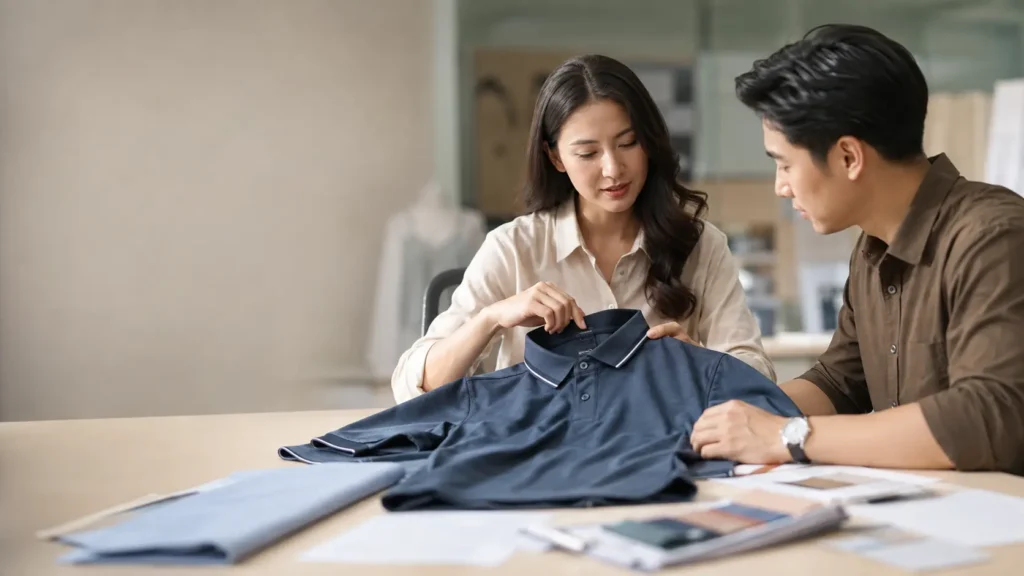
Once the main requirements are agreed, sample development becomes an important part of the clothing manufacturing process. A sample gives both the customer and manufacturer an opportunity to evaluate the product before committing to bulk production.
Depending on the project, the sample may be used to assess:
- Overall appearance
- Fit
- Measurements
- Fabric suitability
- Colour
- Construction
- Printing or embroidery
- Labels
- Finishing details
Sampling is particularly important when a garment has custom construction or specific fit requirements. Instead of assuming that a design will work exactly as expected, the sample creates a physical reference that both sides can review.
A sample is not simply a smaller production order. It is an opportunity to check whether the product works as intended before committing to bulk production.
This is one reason the apparel manufacturing process should not be viewed as a straight line from design to bulk production. There is usually a development stage where products are checked and refined.
6. Sample Review and Revisions
Receiving a sample does not always mean the development stage is finished. You may identify changes related to fit, measurements, fabric, colour, construction, or branding.
For example, you may decide that:
- The body length needs adjustment
- The sleeve should be wider
- The fabric needs more structure
- The logo placement needs to change
- The colour needs to be closer to the original reference
These revisions are a normal part of product development.
The key is to communicate changes clearly. A good clothing production process should establish a clear reference before bulk production. Measurements, materials, colours, artwork, and construction details should be confirmed rather than relying on verbal assumptions.
This is also where you can reduce risk. Fixing a problem during sampling is generally more manageable than discovering the same issue after hundreds of garments have been produced.
7. Production Preparation
Once the sample and specifications are approved, the project can move into production preparation. At this point, the manufacturer needs to coordinate the materials, quantities, production requirements, and schedule.
Depending on the product, this may involve:
- Confirming fabric availability
- Preparing production quantities
- Finalising artwork
- Confirming labels and trims
- Preparing patterns
- Confirming measurements
- Coordinating production requirements
- Planning quality checks
This stage connects product development with the wider apparel production process. It is important to understand that approval of a sample is not simply saying “the sample looks good.” The approved sample and specifications should become the reference for bulk production.
That reference helps everyone work toward the same result. For a broader look at clothing manufacturing, Techpacker’s Ultimate Guide to Clothing Manufacturing also covers areas such as pre-production, production planning, quality control, and delivery.
8. Bulk Production
Bulk production is where the approved product moves into the main clothing production process.
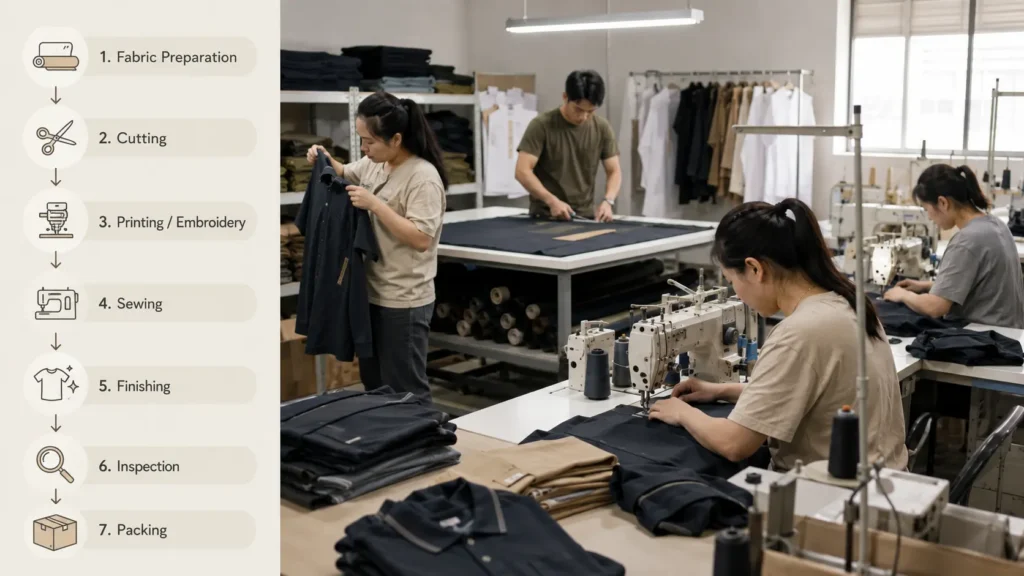
The exact workflow varies depending on the product and manufacturing setup. Depending on the requirements, it may include:
Fabric preparation → Cutting → Printing or embroidery → Sewing → Finishing → Inspection → Packing
Not every garment follows exactly the same sequence. Some processes may happen before sewing, while others take place after the garment has been assembled. Production coordination becomes especially important when several processes or suppliers are involved.
For example, printing, embroidery, special finishing, or other production requirements may need to be coordinated around the main garment construction.
This is why working with an experienced clothing manufacturer is not simply about having someone sew a garment. Clear communication and coordination throughout apparel production can have a major impact on consistency and timing.
9. Quality Checking and Final Inspection
Quality control should not be treated as something that only happens at the end.
During the clothing manufacturing process, potential issues can include incorrect measurements, stitching problems, fabric defects, colour variations, printing issues, or finishing problems. Early identification gives the production team an opportunity to address issues before they become larger problems.
Useful quality checkpoints can include:
- Fabric condition
- Measurements
- Stitching
- Construction
- Colour consistency
- Printing or embroidery
- Labels
- Finishing
- Overall appearance
Our guide to Common Garment Defects and How to Prevent Them covers several issues that can affect finished garments and explains why prevention is important.
The objective is not simply to find defects at the end. A practical apparel manufacturing process should focus on reducing avoidable problems throughout production.
10. Packing and Delivery
After production and final checks are completed, garments can move into packing and delivery.
Packing requirements may vary according to the project’s needs. Some projects require individual polybags, size stickers, specific carton arrangements, or customised packaging. Delivery planning should therefore be discussed before production begins rather than treated as an afterthought.
Delivery planning should therefore be discussed before production begins rather than treated as an afterthought. At this point, the clothing manufacturing process has moved from product development into fulfilment.
Clear documentation and communication remain important until the order is completed.
What Should You Expect From a Clothing Manufacturer?
A professional manufacturing relationship should involve more than receiving a price.
The right clothing manufacturer should be able to communicate clearly about what is feasible, what information is required, what needs to be confirmed, and what happens next.
Before starting a project, it can be useful to ask:
- What information do you need from us?
- What fabric options are available?
- What is the MOQ?
- How does sampling work?
- How long does development take?
- What happens if the sample needs revisions?
- What needs to be approved before bulk production?
- How is production quality monitored?
- What are the expected production and delivery timelines?
At Tris Apparel, our role focuses on apparel development, sourcing, sample development, production coordination, and quality control rather than simply taking an order and sending it into production.
For brands that already have their own designs and specifications, our OEM apparel manufacturing service provides more information about how this type of production support works.
A Better Way to Approach Apparel Production
The clothing manufacturing process can seem complicated when you look at all the individual steps. However, the overall principle is quite straightforward:
Clear requirements → Product review → Material decisions → Quotation → Sampling → Approval → Production → Quality checking → Delivery
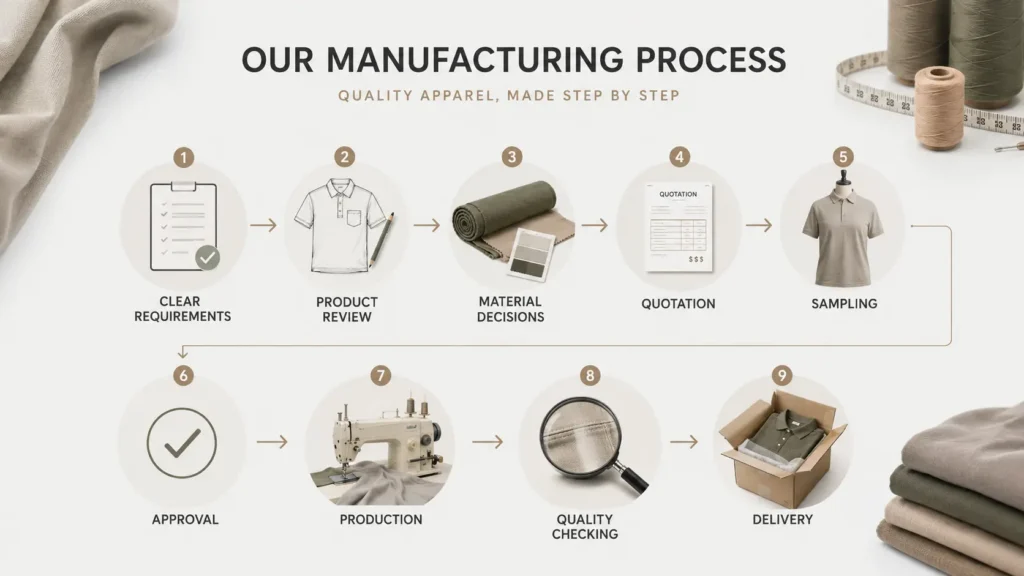
The most important point is that each stage builds on the previous one. A clear product brief helps the manufacturer understand the project. Good material decisions support the sample. An approved sample creates a reference for production. Proper production coordination helps maintain consistency.
In other words, successful apparel production is not only about the final garment. It is also about how well the decisions are managed before and during manufacturing.
You do not need to know every technical detail before contacting a manufacturer. However, being prepared to communicate your product goals, requirements, quantity, and expectations clearly can make the process much easier.
Conclusion
Understanding the clothing manufacturing process helps you approach manufacturers with more realistic expectations.
After the initial contact, a typical project may involve requirement review, fabric selection, quotation, sampling, revisions, production preparation, bulk manufacturing, quality checking, and delivery.
The exact clothing production process can vary depending on the product, quantity, materials, and customisation requirements. However, having a clear understanding of the main stages makes communication easier and helps you make better decisions.
Whether you are developing a new apparel collection, producing uniforms, launching activewear, or expanding an existing product line, understanding the manufacturing process can help turn a product idea into a production-ready garment.
Planning an apparel project? Share your product requirements, design references, quantity, and preferred timeline with Tris Apparel to discuss the next steps.