Reducing Cost Through Smarter Product Construction
Introduction
Apparel production cost is becoming a growing concern in 2026. Brands are facing pressure from multiple directions, including rising material prices, fluctuating freight rates, and tighter production timelines.
In response, many businesses continue to focus on negotiating lower prices with manufacturers. While this approach may provide short-term relief, it rarely creates long-term stability.
The reality is simple.
Apparel production cost is not only determined by pricing — it is shaped by how the product is designed and constructed.
For brands that want to protect margins while maintaining product standards, the focus needs to shift earlier in the process. Instead of asking how to reduce price, the better question is:
How can the product be engineered more efficiently?
- Introduction
- Key Takeaways
- Why Apparel Production Cost Is Increasing in 2026
- The Limitation of Price-Driven Decision Making
- Where Apparel Production Cost Is Actually Determined
- Product Construction as a Cost Control Lever
- 1. Waistband Construction and Cost Efficiency
- 2. Pattern Engineering and Fabric Utilization
- 3. Panel Design and Production Complexity
- 4. Stitching Methods and Manufacturing Efficiency
- Small Improvements, Scalable Impact
- Moving from Supplier to Manufacturing Partner
- Practical Steps to Manage Apparel Production Cost
- A More Sustainable Approach to Cost Management
- Conclusion
Key Takeaways
- Apparel production cost in 2026 is rising due to combined pressures from materials, labor, logistics, and currency fluctuations.
- Price negotiation alone has limited impact on long-term cost control.
- Most cost factors are determined during apparel product development, not during production.
- Product construction decisions directly influence garment construction cost and manufacturing efficiency.
- Small improvements in pattern efficiency and material usage can reduce cost by 3–5% in bulk production.
- Simplifying design and construction can improve consistency while reducing production complexity.
- Working with a manufacturing partner early allows brands to optimize cost before production begins.
Why Apparel Production Cost Is Increasing in 2026
To manage cost effectively, it is important to understand what is driving the increase.
Several factors are contributing to rising apparel production cost:
Material and Component Costs
Fabric remains the largest cost component in most garments. Price fluctuations in yarn, dyeing, and finishing processes directly affect overall cost. Trims such as elastics, zippers, and labels also add up, especially in large volumes.
Labor and Production Constraints
Production efficiency is closely tied to labor. As manufacturing conditions evolve, labor costs and productivity levels influence how much each piece costs to produce.
Logistics and Freight Volatility
Shipping and logistics continue to be unpredictable. Even when production cost is stable, total cost can increase due to freight fluctuations and delays.
Currency Movements
Exchange rates can impact sourcing decisions and pricing consistency, especially for brands working across multiple markets.
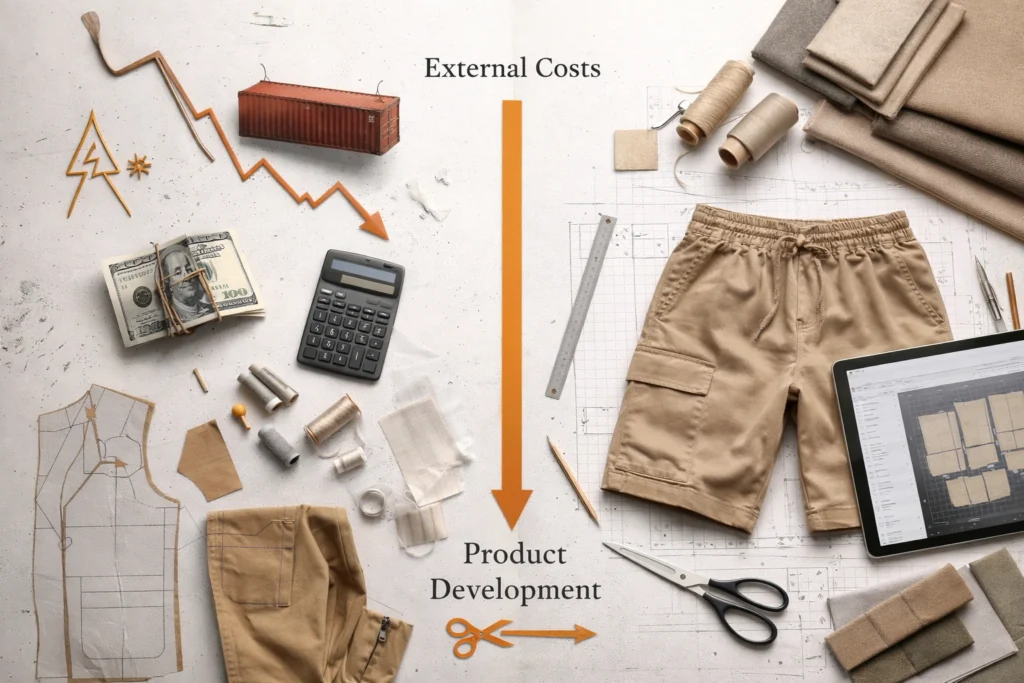
These factors show that rising cost is not driven by a single issue. It is a combination of external pressures.
However, while brands cannot control all external factors, they can control how their products are developed.
The Limitation of Price-Driven Decision Making
When facing higher apparel production cost, many brands rely heavily on price comparison.
This approach has limitations:
- it focuses only on the final quotation
- it ignores inefficiencies in product design
- it often leads to repeated negotiation cycles
More importantly, pricing reflects decisions that have already been made during apparel product development.
Once fabric consumption, pattern layout, and construction methods are fixed, the room for cost reduction becomes limited.
This is why focusing only on price can feel like solving the wrong problem.
Where Apparel Production Cost Is Actually Determined
To achieve meaningful garment cost reduction, brands need to look at the development stage.
Key cost drivers include:
- fabric utilization
- pattern efficiency
- garment construction methods
- component selection
These factors directly influence both material usage and production time.
For example:
- inefficient pattern layout increases fabric waste
- complex construction increases labor time
- unnecessary components add to material cost
By the time production begins, these elements are already locked in.
Therefore, cost should be managed at the design and engineering stage, not only at the pricing stage.
Industry references also highlight that cost reduction in apparel manufacturing is largely driven by improving material efficiency, production planning, and process optimization during early development stages.
Product Construction as a Cost Control Lever
Product construction plays a critical role in determining garment construction cost.
It defines how a garment is built, including:
- panel structure
- seam types
- stitching methods
- component integration
Even small adjustments in construction can improve manufacturing efficiency in apparel production.
Below are key areas where construction decisions make a difference.
1. Waistband Construction and Cost Efficiency
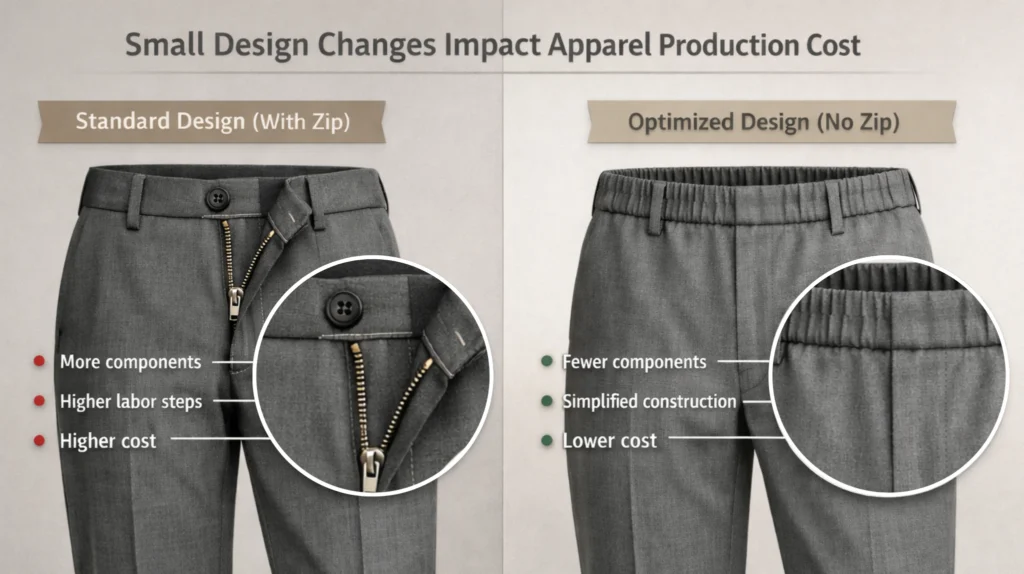
Waistbands are widely used in activewear, kidswear, and casual garments. In recent years, many trousers and shorts have shifted from traditional zipper closures to elastic or hybrid waistband designs.
This change is not only driven by comfort and style, but also by cost and production efficiency.
Compared to zipper construction, waistband designs can reduce several cost components:
- elimination of zipper and related trims
- fewer sewing steps and assembly stages
- shorter production time
- lower risk of defects during installation
In many cases, a well-designed waistband can achieve both functional and aesthetic requirements while simplifying production.
By reviewing waistband construction during product development, manufacturers can:
- reduce material and component usage
- streamline sewing processes
- improve consistency across bulk production
For example, adjusting how elastic is integrated or how the waistband is structured can significantly reduce both material waste and labor time, without affecting the overall appearance of the garment.
2. Pattern Engineering and Fabric Utilization
Fabric efficiency is one of the most important factors affecting apparel production cost.
Pattern engineering focuses on how garment pieces are arranged during cutting.
Through better marker planning, manufacturers can:
- increase fabric utilization
- reduce leftover waste
- improve yield per fabric roll
Even a small improvement of 2–3% can significantly reduce total cost in bulk production.
If you want to understand how different cost elements come together, you can refer to our guide on smart cost control strategies in apparel manufacturing.
3. Panel Design and Production Complexity
The number of panels in a garment directly affects production complexity.
More panels require:
- additional cutting steps
- more sewing operations
- higher coordination during assembly
While detailed designs can enhance visual appeal, excessive complexity may increase cost without adding proportional value.
By refining panel structures, brands can:
- reduce production time
- improve consistency
- lower defect rates
This creates a more balanced approach between design and efficiency.
4. Stitching Methods and Manufacturing Efficiency
Stitching decisions influence both durability and production speed.
Different techniques vary in:
- time required
- machine usage
- skill level needed
In some cases, garments include stitching methods that are not essential.
By selecting appropriate techniques, brands can:
- maintain product performance
- reduce unnecessary labor
- improve overall efficiency
For example, simplifying seam finishes or avoiding excessive reinforcement in non-critical areas can help reduce production time without affecting overall garment performance.
This contributes directly to better manufacturing efficiency in apparel production, especially in bulk orders where small time savings scale significantly.
Small Improvements, Scalable Impact
One of the key advantages of optimizing product construction is scalability.
A 3–5% reduction in apparel production cost may appear small, but its impact grows with volume.
For example:
- across thousands of units
- repeated over multiple production cycles
These improvements accumulate over time.
Unlike price negotiation, which often needs to be repeated, engineering improvements can be applied consistently across future collections.
Moving from Supplier to Manufacturing Partner
In today’s environment, the role of the manufacturer is evolving.
A traditional supplier typically:
- follows given specifications
- provides pricing based on design
- focuses on order execution
A manufacturing partner, however:
- reviews product construction during development
- suggests improvements to reduce cost and complexity
- collaborates with brands to improve outcomes
This shift is important for brands aiming to manage apparel production cost more effectively.

Practical Steps to Manage Apparel Production Cost
To adapt to rising costs, brands can take a more structured approach.
1. Involve Manufacturers Early
Engage your manufacturing partner during product development.
2. Evaluate Construction Before Sampling
Identify opportunities to simplify design and improve efficiency.
3. Focus on Total Cost, Not Just Unit Price
Consider how design decisions affect overall cost.
4. Ask Technical Questions
Discuss fabric usage, pattern layout, and construction methods.
5. Build Long-Term Collaboration
Work with partners who contribute to continuous improvement.
A More Sustainable Approach to Cost Management
Managing apparel production cost in 2026 requires a shift in mindset.
Instead of relying only on price negotiation, brands should focus on:
- better product development decisions
- improved construction methods
- efficient use of materials
This approach supports both cost control and product consistency.
More importantly, it creates a more stable foundation for long-term growth.
Conclusion
Apparel production cost will continue to be influenced by external factors. However, not all aspects of cost are outside of control.
By focusing on product construction and engineering decisions, brands can achieve meaningful improvements in cost efficiency.
This approach does not require compromising product quality. Instead, it encourages smarter design and better collaboration.
At Tris Apparel, we work closely with brands to refine product construction and improve manufacturing efficiency from the early development stage.
If you are looking to manage apparel production cost more effectively, we are ready to support your next project with practical and transparent solutions.
👉 Get in touch to explore how your designs can be optimized for better cost performance.