Introduction
The global athleisure market is no longer just a trend — it represents a structural shift in how people dress. Consumers expect clothing that works at the gym, at work, and during social time. According to Grand View Research, the global athleisure market continues to demonstrate long-term growth, driven by lifestyle changes and increasing demand for versatile apparel.
However, while demand remains strong, margins are tightening. Many new labels enter the market by copying trending styles and lowering prices. This approach may generate short-term sales, but it rarely builds long-term profitability.
If you want to build a high-margin athleisure line, you must design for positioning, pricing power, and operational control — not just production.
This guide explains how to create a profitable athleisure brand with realistic production planning, disciplined pricing, and scalable growth.
- Introduction
- Why High Margins Matter More Than High Volume
- 1. Define a Clear Athleisure Brand Positioning Strategy
- 2. Focus on Product Architecture, Not Random Styles
- 3. Build Margin Through Smart Pricing Strategy
- 4. Use Low MOQ Activewear Production to Protect Cash Flow
- 5. Build Perceived Value Through Brand Experience
- 6. Expand Into High-Potential Athleisure Subcategories
- 7. Optimize Operations for Scalability
- 8. Invest in SEO to Reduce Customer Acquisition Cost
- 9. Control Distribution to Protect Pricing Power
- 10. Think Long-Term: Margin Over Hype
- Conclusion
- Ready to Build Your Athleisure Line?
Why High Margins Matter More Than High Volume
A common mistake in apparel startups is chasing volume too early.
Selling more units does not automatically mean higher profit. In fact, low margins combined with rising logistics costs, marketing expenses, and platform fees can quickly erode cash flow.
In today’s environment, brands must prioritize profit per piece, not just units sold.
A strong margin allows you to:
- Invest in marketing and brand visibility
- Improve sampling and development cycles
- Absorb slower sales periods
- Expand product categories strategically
Without margin discipline, growth becomes fragile. With it, growth becomes sustainable.
1. Define a Clear Athleisure Brand Positioning Strategy
Before sketching your first design, define your brand identity.
Ask yourself:
- Who is your ideal customer?
- What specific problem are you solving?
- Where will your products be worn?
- What emotional value are you offering?
For example:
| Positioning Type | Target Customer | Price Level | Brand Angle |
|---|---|---|---|
| Performance-focused | Fitness enthusiasts | Mid-high | Function + durability |
| Minimal lifestyle | Urban professionals | Mid | Clean aesthetic |
| Modest activewear | Niche communities | Mid-high | Inclusive design |
| Kids athleisure | Parents | Mid | Comfort + flexibility |
Without positioning, products become interchangeable. And interchangeable products cannot command strong margins. Clear positioning strengthens pricing power and reduces direct price comparison.
2. Focus on Product Architecture, Not Random Styles
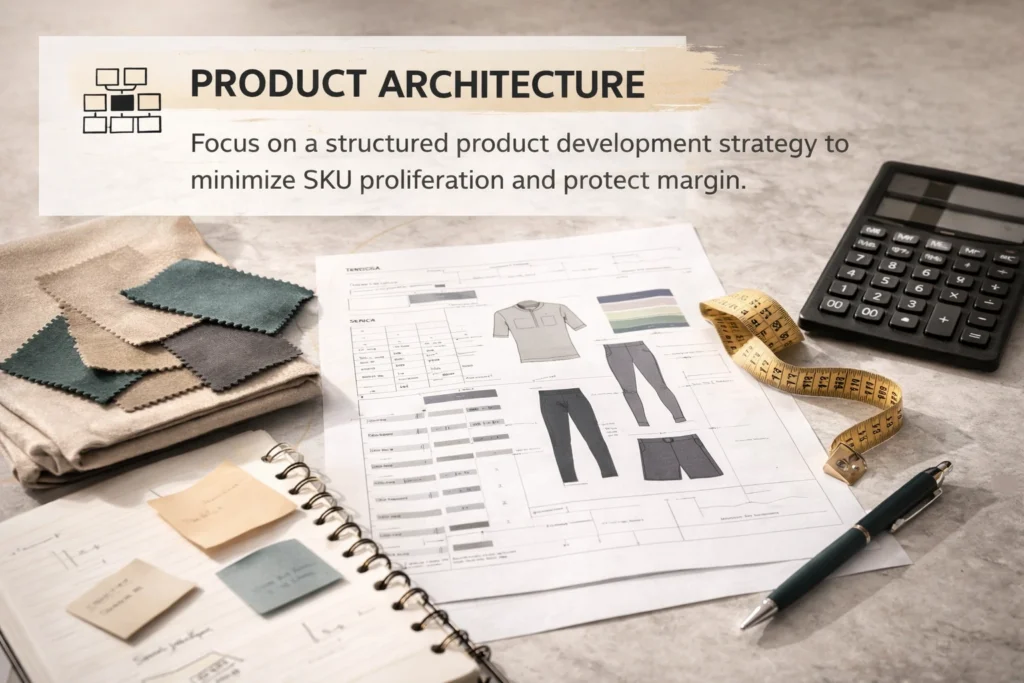
Many new brands release too many SKUs too quickly. This increases inventory risk and slows cash rotation.
Instead, build a structured product architecture:
Core Styles (70%)
Timeless leggings, joggers, polos, and training tops. These drive consistent revenue.
Seasonal Updates (20%)
Limited color releases or controlled design updates.
Experimental Capsules (10%)
Small-batch releases to test new categories.
This disciplined structure protects margins because:
- Development costs are spread over longer cycles
- Reorders become easier
- Inventory risk stays controlled
- Brand identity remains consistent
When products are structured, planning becomes easier and profit forecasting becomes more accurate.
3. Build Margin Through Smart Pricing Strategy
High margins start with pricing clarity.
Many new brands use simple “cost-plus” pricing. While useful, it should not be your only method.
Step 1: Define Target Retail Price First
Position your product clearly in the market.
Step 2: Work Backward
Ensure production and logistics costs allow room for:
- 60–75% gross margin (direct-to-consumer model)
- 40–55% gross margin (wholesale model)
If your cost structure cannot support your target margin, adjust the design structure or operational plan — not your brand positioning too quickly.
Premium pricing works when supported by:
- Strong brand identity
- Clear value communication
- Professional presentation
- Consistent customer experience
Lowering price should be the last solution, not the first reaction.
4. Use Low MOQ Activewear Production to Protect Cash Flow
In today’s market, flexibility is critical.
High minimum order quantities increase:
- Inventory pressure
- Cash flow risk
- Slow design iteration
Working with an OEM activewear manufacturer that supports low MOQ activewear production allows you to:
- Test styles before scaling
- Launch small capsules
- Improve based on market feedback
- Reduce unsold stock
This approach is especially helpful for growing brands in Southeast Asia, where demand exists but scaling happens progressively.
Margin protection is not only about pricing — it is also about risk control.
5. Build Perceived Value Through Brand Experience
Athleisure buyers purchase lifestyle identity, not just clothing.
To increase perceived value:
- Invest in consistent visual branding
- Maintain a clear color identity
- Use professional product photography
- Communicate real usage occasions
- Keep messaging consistent across platforms
Perceived value allows brands to price 20–40% higher than generic alternatives without resistance.
Importantly, value must remain consistent across:
- Website
- Social media
- Packaging
- Customer service
When brand identity is clear, customers compare less on price and more on experience.

6. Expand Into High-Potential Athleisure Subcategories
If your goal is long-term margin growth, avoid over-concentration in one segment.
Consider structured expansion:
1. Athleisure Polo Shirts
Corporate wellness programs and golf-inspired casualwear are growing.
This segment bridges uniforms and smart-casual apparel.
2. Kids Activewear
Parents increasingly choose flexible, sport-inspired everyday clothing for children.
3. Men’s Athleisure
Still less saturated than women’s categories in many regional markets.
Strategic expansion increases:
- Average order value
- Cross-selling opportunities
- Brand lifetime value
However, expand only after your core line stabilizes.
7. Optimize Operations for Scalability
A profitable athleisure brand depends on operational discipline.
Focus on:
- Clear tech pack documentation
- Accurate measurement grading
- Structured sampling feedback
- Realistic production timelines
- Export planning and coordination
Industry frameworks provided by organizations such as the World Trade Organization influence trade conditions and tariffs. Understanding such frameworks helps brands plan long-term export strategies.
Even if you start small, build systems designed for scale. Operational clarity reduces hidden costs and protects margin.
8. Invest in SEO to Reduce Customer Acquisition Cost
Paid advertising costs continue to rise. Social media platforms are increasingly competitive, and performance marketing alone can quickly compress margins.
For athleisure brands, long-term profitability requires balancing paid traffic with organic growth.
Instead of relying only on ads, invest in SEO content that attracts high-intent customers, such as:
- “Best leggings for everyday training”
- “How to choose the right athleisure fit”
- “Men’s performance polo styling guide”
- “Kids activewear buying guide for parents”
This type of content does three things:
- Captures search-driven buyers
- Builds authority within your niche
- Reduces long-term dependency on paid traffic
Internal linking between product pages and educational guides strengthens domain authority and improves ranking stability.
Over time, organic traffic lowers your blended customer acquisition cost (CAC). When CAC decreases while pricing remains stable, net margin improves.
Many athleisure brands underestimate this compounding effect. However, brands that build search visibility early gain a structural advantage in the market.
SEO is not a short-term tactic. It is a margin protection strategy.
9. Control Distribution to Protect Pricing Power
Excessive discounting damages both margin and brand perception.
Avoid:
- Constant promotional cycles
- Heavy reliance on flash sales
- Deep marketplace discounting
Instead, build:
- A strong direct-to-consumer website
- Carefully selected retail partnerships
- Limited-time product drops with controlled quantities
When pricing discipline remains consistent, customers associate your brand with value rather than discounts.
10. Think Long-Term: Margin Over Hype
Trends shift quickly. Social media cycles move fast.
However, profitable athleisure brands are built on:
- Clear positioning
- Stable core products
- Controlled expansion
- Measured growth
You do not need viral success to build a high-margin athleisure line. You need consistency, clarity, and strategic decision-making. Strong margins create room for innovation and resilience.
Conclusion
The athleisure market remains full of opportunity. Yet opportunity alone does not guarantee profitability.
To build a high-margin athleisure line, focus on:
- Athleisure brand positioning strategy
- Structured product architecture
- Disciplined pricing strategy
- Low MOQ activewear production
- Strategic category expansion
- Operational efficiency
- SEO-driven long-term growth
Margin is not created by chance. It is built through structured decisions across branding, production, and distribution.
Ready to Build Your Athleisure Line?
If you are developing a structured and scalable athleisure brand and require an experienced OEM partner to support sampling and production planning, connect with Tris Apparel.
We support brands with clear positioning, organized development processes, and reliable export coordination.
Build your high-margin athleisure line with strategy — and long-term confidence.