The “Safe Choice” That Isn’t Always Safe
Introduction
For many brands, 100% cotton t-shirts feel like the safest starting point. They are familiar, widely accepted, and easy to source as wholesale t-shirt blanks. On the surface, the decision seems simple.
However, once production begins, the reality often shifts.
Shrinkage, inconsistent sizing, and post-wash performance issues can quickly turn a “safe” fabric into a costly mistake. This is why the debate around cotton vs blended t-shirts is no longer just about comfort—it is about scalability, consistency, and long-term profitability.
In today’s competitive market, choosing the best fabric for t-shirt manufacturing is not a design decision alone. It is a strategic apparel manufacturing fabric choice that directly affects customer satisfaction and repeat orders.
- Introduction
- Key Takeaways
- Why 100% Cotton T-Shirts Became the Industry Default
- The Real Problems with 100% Cotton T-Shirts in Bulk Production
- Why Many Brands Quietly Switch to Blends
- Cotton vs Blended T-Shirts: A Practical Comparison
- When 100% Cotton T-Shirts Still Make Sense
- How to Choose the Best Fabric for T-Shirt Manufacturing
- The Most Common Mistake Brands Make
- Conclusion: Smart Fabric Choices Build Stronger Brands
- Start with the Right Fabric Before You Scale
Key Takeaways
- 100% cotton t-shirts are not always the safest choice for bulk production.
- Shrinkage and shape loss lead to returns and customer complaints.
- Fabric choice directly affects print quality and production consistency.
- Blended fabrics offer better stability for scaling and repeat orders.
- The real cost is measured per successful sale, not per piece.
- The best fabric depends on usage, not assumptions.
Why 100% Cotton T-Shirts Became the Industry Default
To understand the current mindset, it helps to look at why 100% cotton became so dominant in t-shirt production.
First, cotton is a natural fiber. Many consumers associate it with comfort and breathability. This perception makes it easier for brands to position products in the market.
Second, cotton performs well in certain decoration methods. For example, Direct-to-Garment (DTG) printing works best on cotton because the fibers absorb ink effectively. This makes it a popular choice for brands focusing on graphic t-shirts.
Third, cotton is widely available. Suppliers around the world offer wholesale t-shirt blanks in cotton, making sourcing relatively straightforward.
However, what works well in small batches or sampling does not always hold up in bulk production. At scale, fabric performance matters more than familiarity.
The Real Problems with 100% Cotton T-Shirts in Bulk Production
1. Shrinkage Creates Immediate Customer Friction
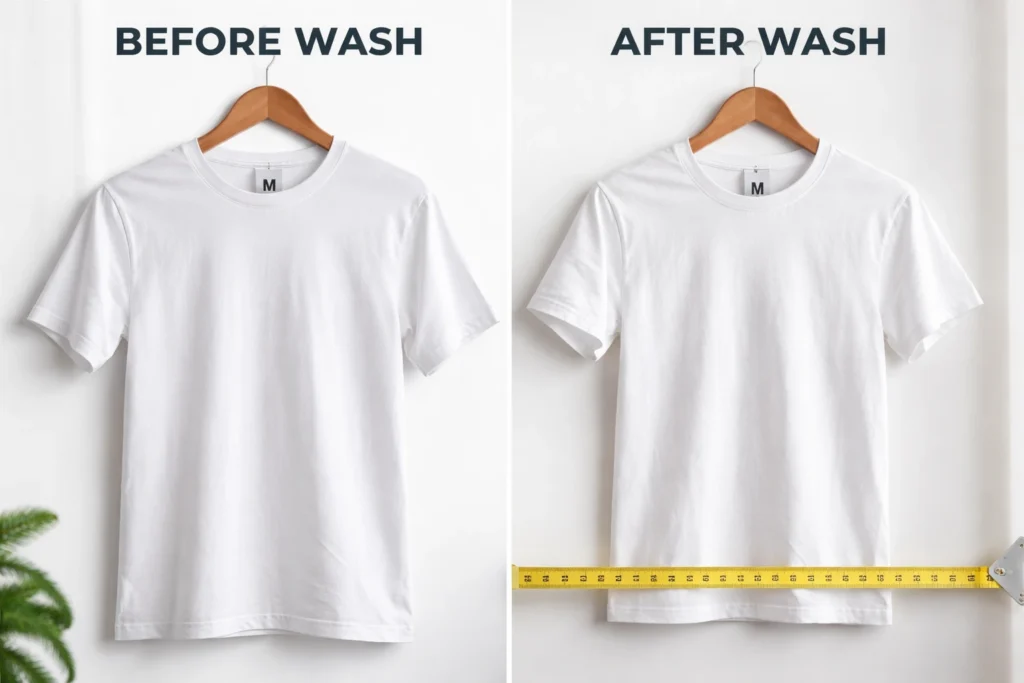
One of the most common issues with 100% cotton t-shirts is shrinkage after washing.
Even with pre-shrunk treatments, variations still occur. This happens because cotton fibers expand and relax when exposed to moisture and heat, leading to dimensional changes after laundering, as explained by ScienceDirect.
As a result, customers may receive a product that fits differently after the first wash. For brands, this leads to:
- Size complaints
- Returns and exchanges
- Negative reviews
Over time, these issues affect brand trust. This is why shrinkage is not just a technical problem—it is a business problem.
2. Shape Retention Becomes a Long-Term Issue
Another challenge is structural stability. Cotton fibers tend to lose shape faster compared to blends.
Necklines may stretch. Side seams may twist. The garment may lose its original form after repeated washing.
For brands selling everyday wear, this directly impacts perceived value. While the t-shirt may feel comfortable at first, it may not maintain that standard over time.
3. Moisture Retention Limits Performance
While cotton absorbs moisture well, it does not release it efficiently.
This means 100% cotton t-shirts tend to:
- Hold sweat longer
- Dry more slowly
- Retain odor
For categories like activewear or uniforms, this becomes a clear disadvantage. In contrast, when evaluating cotton vs blended t-shirts, blends often provide better moisture management.
4. Inconsistent Results Across Production Batches
Cotton quality can vary depending on source, processing, and yarn quality.
This creates a challenge in scaling. A sample may perform well, but bulk production may behave differently.
For brands planning repeat orders, this inconsistency makes it harder to standardize products. As a result, the apparel manufacturing fabric choice becomes a risk factor if not carefully managed.
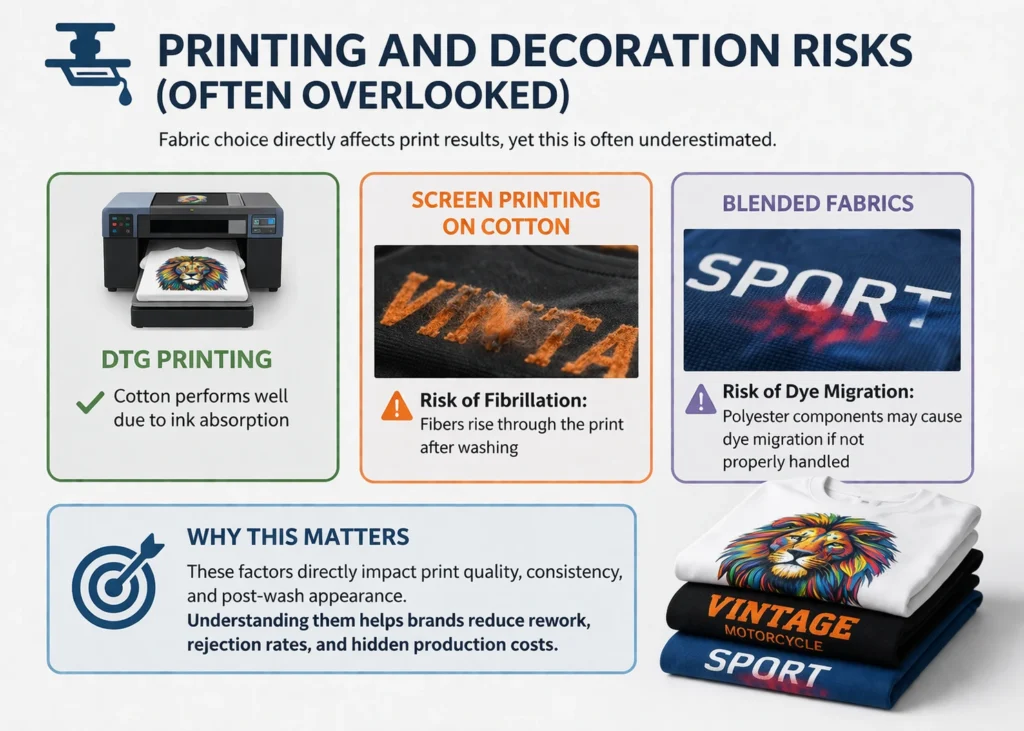
5. Printing and Decoration Risks (Often Overlooked)
Fabric choice directly affects print results, yet this is often underestimated.
- DTG Printing:
Cotton performs well due to ink absorption - Screen Printing on Cotton:
Risk of fibrillation, where fibers rise through the print after washing - Blended Fabrics:
Polyester components may cause dye migration if not properly handled
These factors directly impact print quality, consistency, and post-wash appearance.
Understanding these factors helps brands reduce rework, rejection rates, and hidden production costs.
Why Many Brands Quietly Switch to Blends
Despite the popularity of cotton, many brands gradually shift toward blended fabrics.
This decision is rarely driven by trends—it is driven by performance and cost efficiency.
The Hidden Cost of “Cheaper” Cotton
At first glance, cotton may appear cost-effective. However, the real cost includes:
- Returns due to shrinkage
- Customer dissatisfaction
- Inconsistent repeat orders
- Printing defects
When these factors are considered, the fabric choice becomes a business decision—not just a material preference.
Blended fabrics—such as cotton-polyester mixes—often deliver:
- Better dimensional stability
- Reduced shrinkage
- Improved durability
- More consistent bulk production results
In many cases, this results in a lower cost per successful sale.
Cotton vs Blended T-Shirts: A Practical Comparison
| FACTOR | 100% COTTON T-SHIRTS | BLENDED T-SHIRTS |
|---|---|---|
| Comfort | High | High |
| Shrinkage | Higher risk | More controlled |
| Durability | Moderate | Higher |
| Moisture Handling | Limited | Improved |
| Print Stability | Good (DTG) | Stable (managed) |
| Bulk Consistency | Variable | More reliable |
This comparison highlights why the best fabric for t-shirt manufacturing depends on the product’s purpose, not just initial feel.
When 100% Cotton T-Shirts Still Make Sense
Despite the challenges, 100% cotton t-shirts are not obsolete.
They still work well in specific scenarios:
- Brands focusing on natural fiber positioning
- DTG-heavy graphic collections
- Small-batch or limited-edition releases
- Babywear or sensitive-skin categories
In these cases, the benefits of cotton can outweigh its limitations.
How to Choose the Best Fabric for T-Shirt Manufacturing
Selecting the best fabric for t-shirt manufacturing requires a structured approach.
Instead of relying on assumptions, brands should evaluate:
1. Product Purpose
Is the t-shirt designed for daily wear, sports, or fashion?
2. Printing Method
Will the design use DTG, screen printing, or embroidery?
3. Washing and Usage Behavior
How often will customers wash and wear the product?
4. Scalability
Can the fabric maintain consistency across large orders?
5. Supplier Capability
Can your manufacturer ensure stable quality across batches?
A structured evaluation reduces risk and improves consistency across production and customer experience. To explore the different fabric options we work with and how they perform in production, check out our fabrics guide.
Ultimately, the apparel manufacturing fabric choice should align with both product positioning and operational realities.
The Most Common Mistake Brands Make
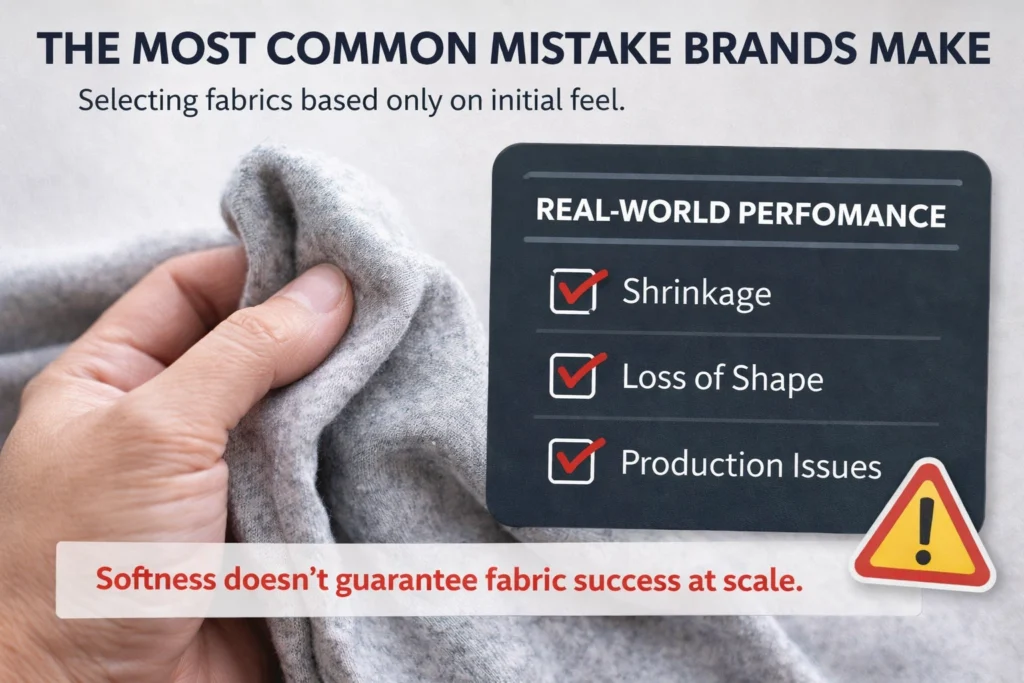
Many brands select fabrics based on how they feel during sampling. However, this approach overlooks real-world performance.
A fabric that feels soft in hand may:
- Shrink after washing
- Lose shape over time
- Perform poorly in bulk production
This is why fabric decisions should focus on real usage, not just first impressions.
Conclusion: Smart Fabric Choices Build Stronger Brands
100% cotton t-shirts are not a wrong choice—but they are not always the best one.
Blended fabrics often solve key production challenges, especially when brands aim to scale. By understanding the trade-offs between different fabric options, businesses can make more informed decisions.
In the long run, the best fabric for t-shirt manufacturing is the one that balances comfort, consistency, and cost efficiency.
Start with the Right Fabric Before You Scale
Choosing the right material is not just a technical step—it is a strategic decision.
If you are planning your next collection or evaluating wholesale t-shirt blanks, take the time to assess performance beyond the sample stage.
👉 Get in touch with our team to discuss fabrics, sourcing, and production options: Contact Tris Apparel
A well-informed apparel manufacturing fabric choice today can prevent costly adjustments tomorrow.